The work centers around crystalline, porous materials known as metal organic frameworks, often abbreviated as MOFs, and points toward next-generation materials that may end reliance on rare earth metals.
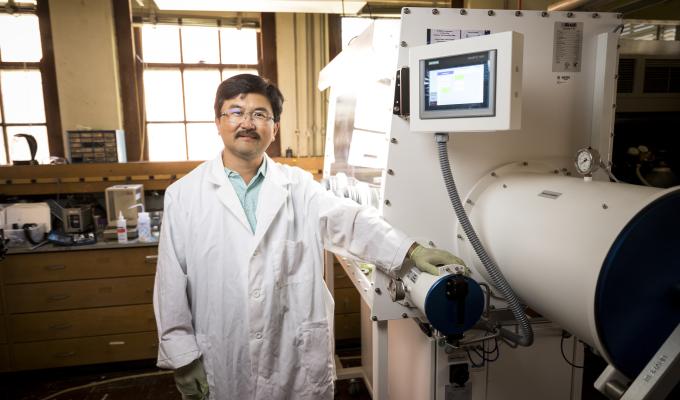
A team of scientists led by chemist Chong Fang has discovered a new way to visualize and track chloride ions in living systems, opening the door to accelerated research on diseases like cystic fibrosis, epilepsy and certain cancers.
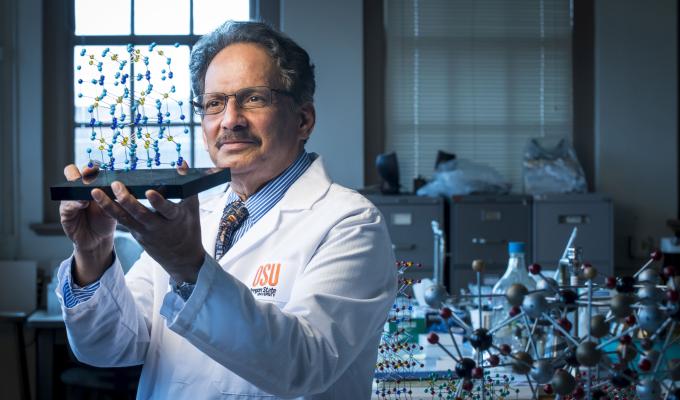
Mas Subramanian and his team found a way to transform an old Norwegian mineral and common metals into vivid pigments that resist fading and heat while offering new sustainable uses.
A College of Science alumna and a Ph.D. student have been awarded 2025–26 Fulbright U.S. Student Program grants to conduct research abroad. They join 17 College of Science students and alumni who have earned Fulbright honors over the past decade.
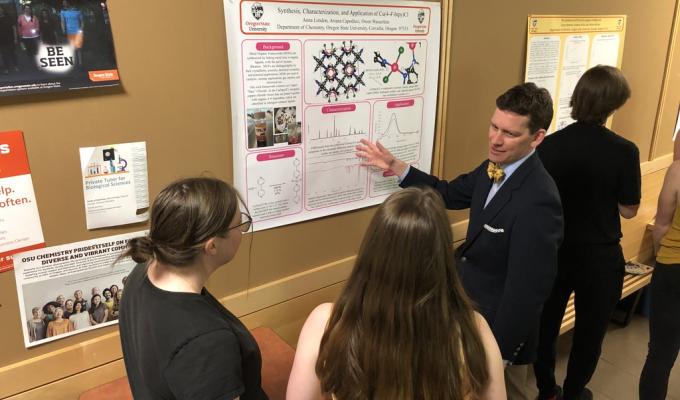
The College of Science will host its inaugural Graduate Research Showcase from 11:30 a.m. to 2:30 p.m. on Friday, May 16, 2025 in the Memorial Union Horizon Room.
Light is more than just illumination – it’s the energy that makes life possible. Physical chemist Tim Zuehlsdorff is using his coveted National Science Foundation Faculty Early Career Development (CAREER) award to study what happens when molecules interact with light in dynamic environments, such as solvents or proteins.
Scientists including an Oregon State University chemistry researcher have taken a key step toward next-generation optical computing and memory with the discovery of luminescent nanocrystals that can be quickly toggled from light to dark and back again.
College of Science researchers have synthesized new molecules able to quickly capture significant amounts of carbon dioxide from the air, an important tactic in climate change mitigation.
Oregon State University scientists have found a way to more than double the uptake ability of a chemical structure that can be used for scrubbing carbon dioxide from factory flues.
In the pursuit of large-scale, reliable, safe, environmentally sustainable and affordable electricity storage, chemist Xiulei “David” Ji is part of a collaborative, interdisciplinary team funded by the U.S. Department of Energy.
Faculty, staff and graduate students from the College of Science won nine awards at University Day, the celebratory kickoff to the academic year featuring an annual awards ceremony. These awards highlight excellence in teaching, advising, research and diversity advocacy, showing the College as a leader across the university.
Researchers from the College of Science, including graduate students, have developed a material that shows a remarkable ability to convert sunlight and water into clean energy.
One course stands out for its creative new approach to the age-old question, “Why does this matter?”— a three-week general chemistry laboratory on metal-organic frameworks (MOFs) pioneered at Oregon State. Two members of the Department of Chemistry, Assistant Professor Kyriakos Stylianou and graduate student Karlie Bach, were interested in invigorating chemistry education and fostering student enthusiasm for research through hands-on laboratory experiences.
A collaborative team co-led by a College of Science researcher have taken a key step toward closing the knowledge gap with a study that indicates silver nanoparticles’ shape and surface chemistry play key roles in how they affect aquatic ecosystems.
Wei Kong enjoys taking the road less traveled, and she is not timid in making bold decisions to get oriented and reoriented. On May 13, 2024, she will present the 2024 F.A. Gilfillan Memorial Lecture, titled “Which way up: Using field orientation to see the unseen.”
Oregon State University Distinguished Professor and Milton Harris Professor of Materials Science, Mas Subramanian, has been elected a fellow of the Neutron Scattering Society of America for “his insightful application of neutron scattering to provide far-reaching insights into materials chemistry.”
Collaborative science has the power to change the world. The 2024 College of Science Research and Innovation Seed (SciRIS) award recipients aim to use that power to develop better treatments for cancer and unlock the mysteries of complex mathematical equations.