Collaborative science has the power to change the world. The 2024 College of Science Research and Innovation Seed (SciRIS) award recipients aim to use that power to develop better treatments for cancer and unlock the mysteries of complex mathematical equations.
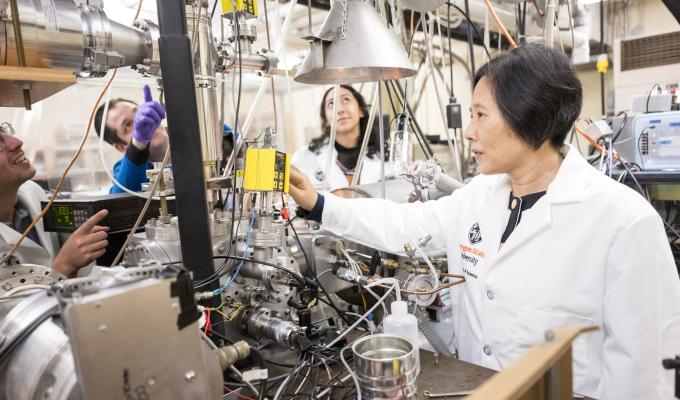
One project keeps chemist Wei Kong awake at night, and it started as an idea nearly two decades ago. Now, after being awarded nearly $2 million for four years by the National Institutes of Health, the goal is to create a groundbreaking new tool with the potential to revolutionize drug development and enhance our understanding of disease mechanisms.
Seed funding from the College of Science Research and Innovation Seed (SciRIS) program continues to bolster ambitious and expansive research projects across biomedical science, fluid dynamics, quantum mechanics and more.
Path-breaking innovations from the College of Science at Oregon State University hold answers to critical problems in the environment, energy and healthcare.
The COVID-19 pandemic is creating a surging interest in science and medicine, attracting a new generation of students to a career in medicine. Enrollment in the College of Science’s pre-med program at Oregon State University has also remained high, with numbers averaging 90-100 pre-med students annually since 2019.
The College of Science awarded two interdisciplinary teams funding to pursue promising leads in mental health and cancer research. One team will investigate the role of the gut-brain axis on sex differences in anxiety, and another will explore ways to develop an synthetic version of HHT-- a rare plant alkaloid that is showing great promise in the development of new medicines for multiple forms of cancer.
The Science Research and Innovation Seed awards were given to four multidisciplinary research teams working on cancer diagnostics and materials science.