A childhood spent tagging along on veterinary calls sparked Oregon State University alum Thomas Webb’s lifelong curiosity about how the world works. Decades later, that same curiosity now shapes his legacy by supporting the tools that help future chemistry students explore it for themselves.
Sensat was awarded for his work developing new chemistries for adaptable polymer networks; providing materials for industrial and biomedical applications.
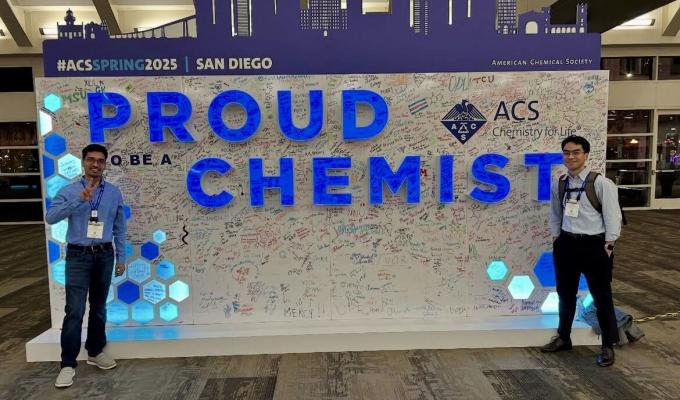
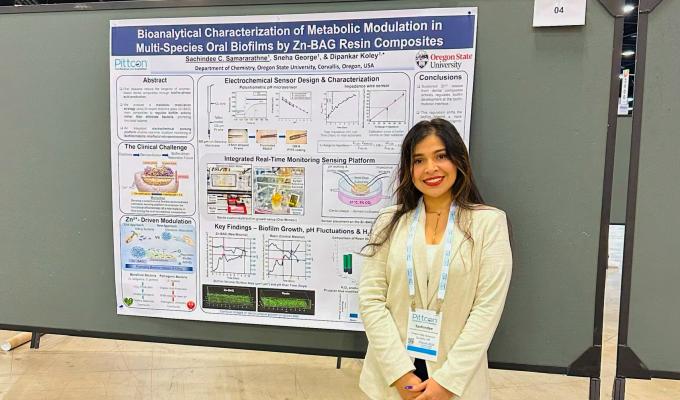
For graduate students in chemistry at Oregon State University, conference season is more than a professional milestone — it’s a launchpad for future careers. Each year, students share discoveries and gain experience presenting their work, but conference travel is costly, and not all research groups can fund the experience. This Dam Proud Day, we're rallying to offset these costs to ensure no budding scientist is kept from this important milestone.
The College of Science and Department of Biochemistry and Biophysics at Oregon State University have received a $450K award from the M.J. Murdock Charitable Trust to establish the Partners in Science program on the Corvallis campus.
The novel sensor, which also has potential applications in health care and environmental monitoring, is based on the design principle of engineered interfacial chemistry. Funded by the National Science Foundation, the study by scientists at Oregon State and researchers in Taiwan was published in Applied Nano Materials, a journal of the American Chemical Society.
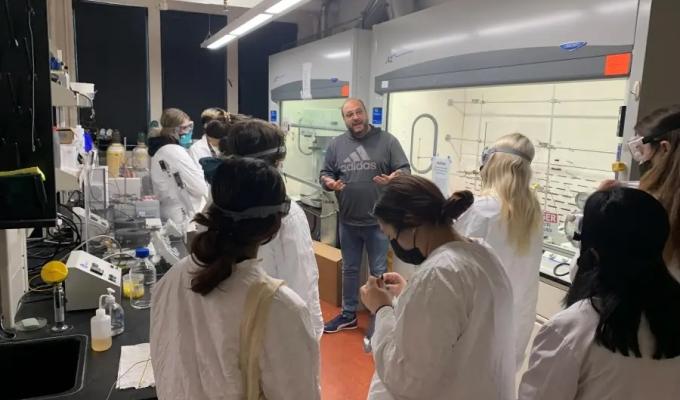
The honors general chemistry sequence is one of the longest-running honors offerings at OSU, and the three-term series gives participating students access to advanced laboratory experiences, faculty mentorship and a learning community that often shapes their academic paths in their very first year.
“Beyond being a scientist,” says Doctor Stephen, this term’s Graduate Student of the Quarter, “one of my interests is contributing to the society where I find myself.”
One day, in chemistry class at Hermiston High School, Trey Stephens-Cherry watched as his teacher let a piece of sodium plummet into a bucket full of water. The resulting explosion kickstarted a passion for chemistry that propelled him into the chemistry major at Oregon State University.
Over a handful of years, Audrey Garrison has gone from a high school student with an interest in chemistry to a scientist taking on the pollutants in our water and soil.
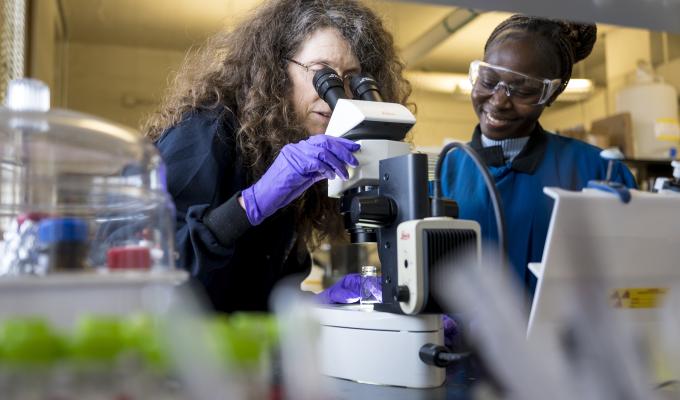
In the College of Science, materials scientist May Nyman and doctoral student Esther Julius are designing molecules that could help push the limits of traditional semiconductor manufacturing.
Margie Haak, a senior instructor in Oregon State University’s Department of Chemistry, has received the 2026 Outstanding Educator – Higher Education Award from the Oregon Academy of Science, recognizing more than three decades of dedication to teaching, mentorship and science outreach.
Both of the 2026 publications involve fluorescent proteins and their “core” chromophores that were first discovered in marine organisms such as jellyfish and coral. The earlier work focused on novel red-emitting graphene-sheet-based carbon dots engineered by the Cheng lab at College of Engineering.