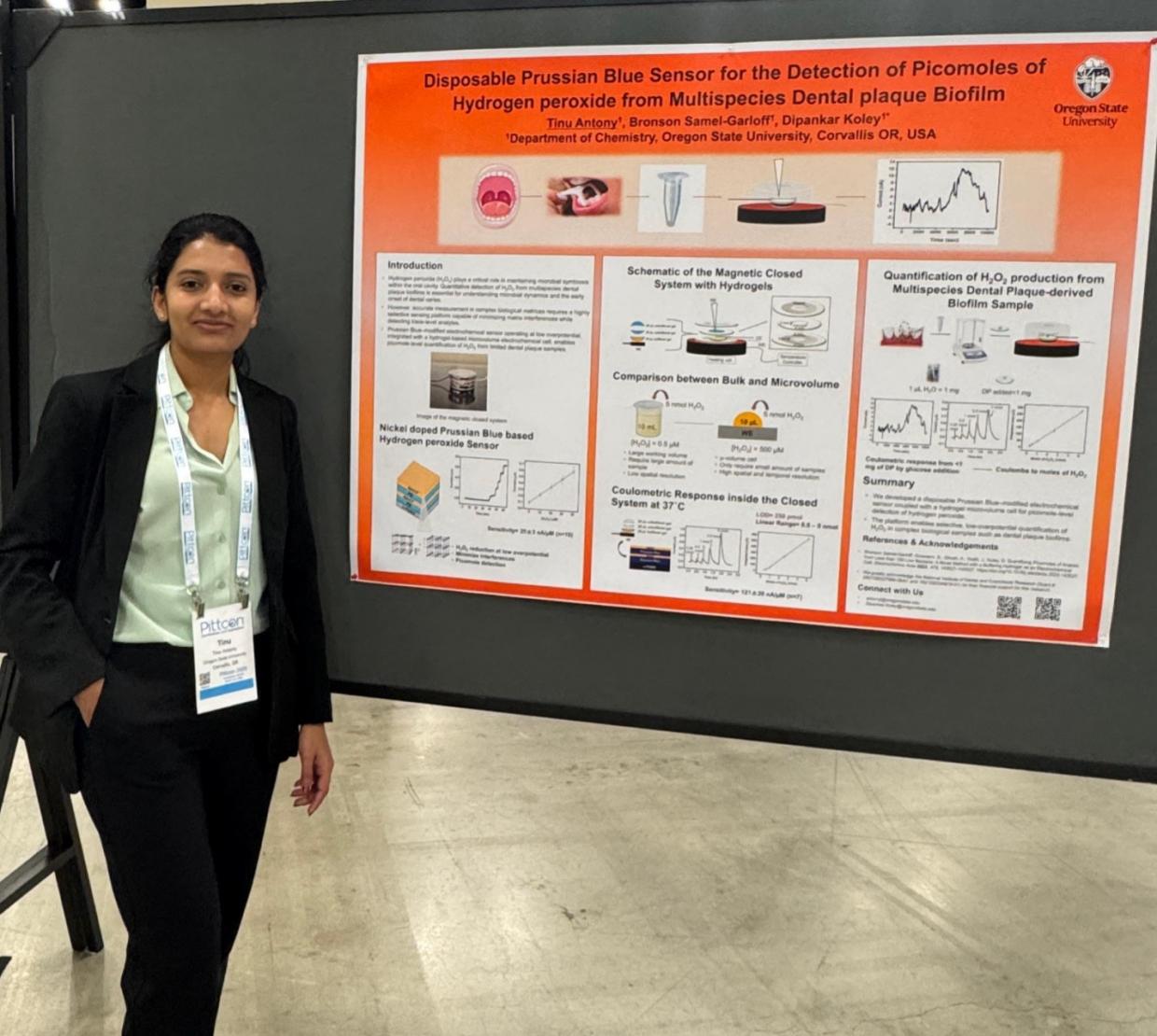
Prussian Blue may be best known for its captivating color, but a graduate student at the Oregon State University Department of Chemistry is tapping into its biomedical potential. Tinu Antony, in conjunction with her colleagues in Dipankar Koley’s lab, recently traveled to Pittcon 2026 in San Antonio, Texas to share her research on a new electrochemical sensor for biological studies that uses Prussian Blue to selectively detect chemicals associated with dental caries.
The current treatment for dental caries, Antony explains, is a filling after the damage has already been done. “We don’t have any tool to predict if there is a possibility of getting caries on your tooth,” Antony says. “With this particular research, what we are aiming for is to have a point-of-care device in the future where we can collect the dental plaque from one individual and detect the hydrogen peroxide and see how the microbiome is for that particular individual.”
Antony’s sensor is a key step on the path to personalized, preventative dental care that helps people protect themselves from ever getting dental caries in the first place.
Seeking a place where she could both do research and gain experience teaching, Antony moved from India to the U.S. and started work in the Koley lab at Oregon State University. There, she began researching electrochemical devices that can gather useful data about an individual’s oral health. Her research is interdisciplinary in nature, “involving chemistry, biology, and engineering”, Antony says, “so you get to explore all these three areas in the same lab, doing this research.”
Sensors need to be able to detect specific chemicals—analytes—to work. However, oral bacteria tend to create a lot of different byproducts as they live, reproduce, and die in the mouth. In the same way that algae in the water can make it harder to spot a penny at the bottom of a fountain, these byproducts can make it hard for sensors to find the analytes they’re looking for. In Antony’s case, her sensor’s analyte is hydrogen peroxide, a potential indicator of early tooth damage.
“I need a sensor which is really selective, and which responds only to my analyte,” Antony explains. This is where the Prussian Blue comes into play. The compound works as a catalyst that responds to hydrogen peroxide but not to other chemicals. In addition to being selective, it’s a highly practical material to use in this work. “It’s a low-cost material and you can prepare that in situ on an electrode surface,” Antony says. The reactions between Prussian Blue and hydrogen peroxide allow Antony to detect the analyte, even with many other chemicals in the mouth.
The result is a sensor that can reliably spot the telltale signs of tooth decay. Antony showcased this sensor and its applications at Pittcon, the first research conference she has attended.
“Pittcon really was a great time, where we could actually listen to great people talking about their research and being passionate about what they’re doing,” Antony says.
One of those people talking about their research was Frances Arnold, a chemist whose work tinkering enzymes to do what they couldn’t do before—thus allowing humans to influence evolution in new ways—has earned her a Nobel Prize.
“It was really eye-catching, because she was able to get the attention of a huge audience,” Antony says. Arnold’s skillful science communication inspired Antony, and showed her how a strong presentation can get people invested in scientific research, even research in complex or esoteric areas.
Perhaps the most important thing Antony got out of the conference was a chance to talk with other chemists outside of her own lab. “We rarely get to interact with people, especially during a PhD,” Antony says. “A conference, I think, is the only way where you meet the people who work on different research areas, and you get new ideas.”