Imagine if you could wear a tiny, harmless device that told you what was going on with your health, exactly as it was happening. You could learn, for example, whether you were likely to get a cavity before that cavity ever appeared. You could also see the signs of early aging thanks to a sensor on your body. This is the future that Oregon State University Department of Chemistry graduate student Pavel Sengupta is helping to build with his research. Sengupta, working with P.I. Dipankar Koley and a team of researchers in the Koley Lab, is creating and refining electrochemistry-based personal sensors that provide minute-by-minute data about the wearer’s health. The lab research has been funded by the NIH over the years.
Sengupta, an analytical chemist, first became intrigued by electrochemistry while getting his master’s degree in India. That fascination led him to the Koley Lab, where Prof. Dipankar Koley and his team are researching electrochemical sensors, systems and devices to use in healthcare and environmental science. Theseinnovations are helping researchers answer scientific questions at interfacial levels in micro and macro environments.
After working with oxygen sensing in oral bacterial biofilms — small bacterial ecosystems that provide specific information about the mouth of the donor — Sengupta forged a new path.
“One of the cool aspects [of working in the Koley lab] is that you can also branch out in cutting-edge specialized technological ideas backed by innovative science, as I have done,” Sengupta says. Now, instead of focusing specifically on sensors in the mouth, Sengupta is further improving the sensors themselves.
The critical challenge hindering reliability and wide use of wearable or remote sensors is the need to calibrate the sensors each time you use them. Having to constantly recalibrate a sensor that someone is actively wearing is not only inconvenient and unfeasible; it can also lead to errors that compromise the data.
“If you have used a pH probe, you know that it needs to be calibrated every day or every few days,” Sengupta explains. “We wanted to go away from that, because if you have a wearable sensor, you don’t have the luxury of taking the sensor off, calibrating it, and then putting it back on your body. That doesn’t make sense.”
To build sensors that don’t have the re-calibration issue, Sengupta is researching solid-state ion-selective electrodes.
“Solid-state ion-selective electrodes are a very different way of fabricating ion-selective electrodes,” Sengupta says. These electrodes, he explains, differ in critical ways from liquid-based electrodes, like a typical pH sensor. The electrodes Sengupta and his team developed are made from layers of solid-state materials, including conductive polymers. “With those, you can miniaturize electrodes,” Sengupta says, “and you can squeeze electrodes to fit into a miniaturized space or for a very small volume or fabricate it in different shapes. This aspect helps us in having very, very different applications ranging from measuring analytes of interest in biofilms and biofluids to quantifying cations in soil water.”
As a result of their distinct design, these solid-state electrodes don’t require constant re-calibration the same way other ion-selective sensors do. As a result of the way these electrodes are fabricated, “we can have an ion-selective sensor that we calibrate once, and we can use it reliably for a long period of time,” Sengupta explains. This has been a major bottleneck in the future development of solid-state ion-selective sensors. In the 2024 and 2025 Pittcon conferences Sengupta attended, he presented his work on long-term stable and robust solid-state reference electrodes and calibration-free ion-selective electrodes for wearable and non-aqueous systems. Ion-selective sensors offer zero-current ion activity measurement versus a reference electrode. Useful solid-state reference electrodes have been another critical challenge in the future development of wearable or remote sensing.
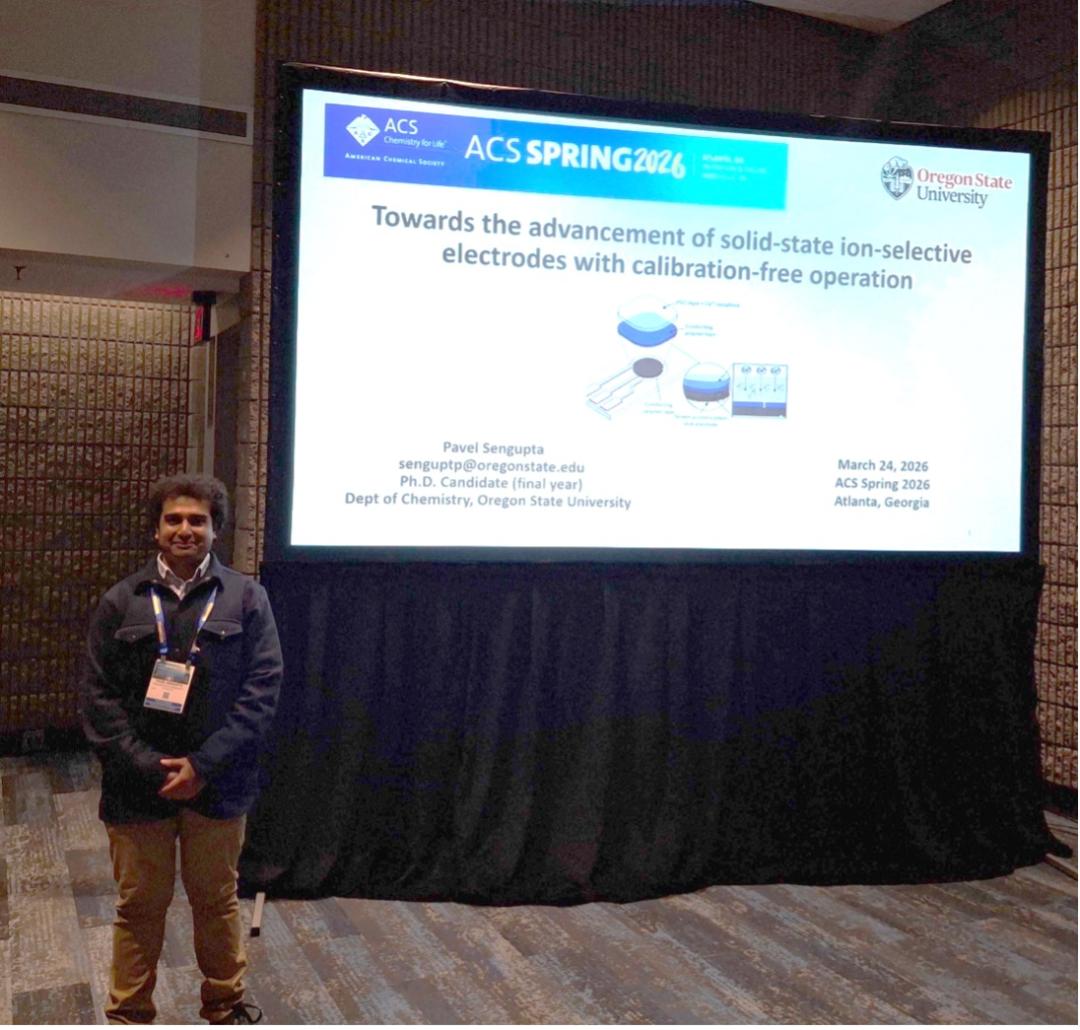
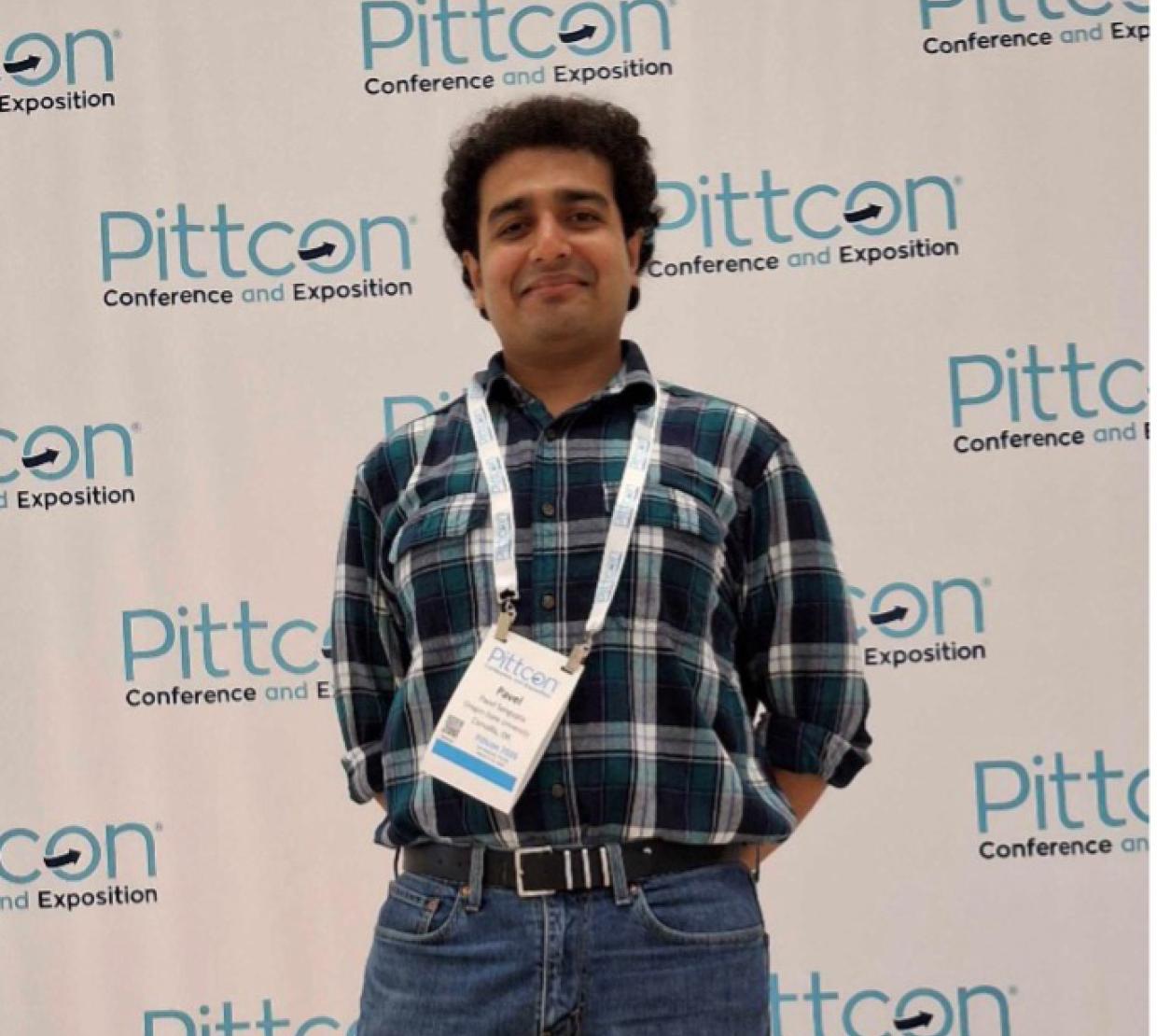
These calibration-free solid-state ion-selective sensors were the subject of Sengupta’s two most recent presentations, one at Pittcon 2026 and one at the American Chemical Society (ACS)’s Spring 2026 meeting. One of the unique challenges Sengupta encountered was making his presentation work for each audience. While Pittcon was mostly attended by analytical chemists like him, the ACS meeting invited chemists of all stripes, from inorganic chemists to biochemists.
“For Pittcon […] I knew that my audience was mainly electrochemistry and analytical chemistry people,” Sengupta says, “versus in ACS, you have to tailor it towards a more generalized audience.”
The ACS meeting, Sengupta notes, was “a very unique learning experience for me, because when I was looking at the different speakers who were before me or after me, I realized that was a very diverse audience. And it was interesting, because now I have to not only focus on analytical chemistry but also make our work appeal to other scientists who might not know electrochemistry.”