Where are you from, where did you grow up?
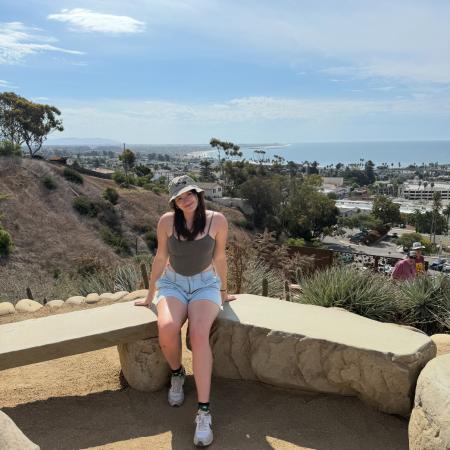
I live in Redlands, CA, which is about 45 minutes from Palm Springs. I grew up in Bellflower, CA. My family moved to Irvine, CA while I was in college. I consider all three places home.
Tell us a bit about your family?
Both of my parents are retired; my dad had a career as an architect and my mom taught English literature at my high school. These days they spend about half of the year traveling around the country in their Airstream trailer—they went through Corvallis last summer and will be returning to Oregon again this summer. I have an older sister who is an ER nurse and works in Los Angeles. She and her husband have four kids.
Why the Department of Chemistry at OSU?
I have said this before, but my job at OSU is a “unicorn” job for me. I had been teaching chemistry part-time at a small, private undergraduate college that discontinued their chemistry program due to lack of enrollment, which effectively ended my time there after 11 years. My disability makes it nearly impossible for me to work a “normal” full-time job as a chemistry teacher, so when I found the listing for the full-time Ecampus instructor position teaching general and organic (!!) chemistry that I could do from home, all the pieces fit together. It has been an amazing experience so far and I can truly say that I love my job.
What are some of the experiences that are most meaningful to you – with students?
Honestly, any time that a student expresses gratitude for the hard work and effort that I put into my classes is a meaningful experience. All too often I think students take for granted (or don’t understand) the thought, care, preparation, and implementation that goes into teaching a class; or they assume that the instructor/professor doesn’t want to be teaching it or has no investment in the success or well-being of students. So when students take the time to say thank you, or to tell me that a video I made helped something finally click, or that the structure of the course made it easier for them to succeed, it really means a lot. It’s nice to know that the effort I put in (whether behind the scenes in the course design or through active participation in the discussion boards or office hours) is making a difference. Those moments remind me why I teach: to support students, meet them where they are, and help them build confidence in their ability to learn chemistry, whether they’re future chemists or just trying to fulfill a requirement. That recognition, however small, is incredibly rewarding to me.
What has surprised you about working in the field of chemistry?
I don’t know if I would say that it “surprised” me, but I am always amazed when I see the research side of things. I have never considered research to be my strong suit, so when I see my colleagues come up with brilliant ideas to explore or ingenious experiments that prove crucial in furthering our understanding of chemistry, it is always inspiring to me. Our chosen field is so rich and deep, in its history, theory, and experimentation. It is truly a model science!
Tell me about someone who has influenced your decision to pursue a career in chemistry?
In general, my professors at the University of Redlands where I did my undergraduate degrees. When I entered college, my plan was to do a double major in biology and chemistry, although I primarily saw myself as a “biology person,” and I was not fully committed to the idea of making chemistry my career. However, the further I progressed in my program, the more I enjoyed chemistry and the less I enjoyed biology. My chemistry professors were awesome, as were my fellow chemistry majors: they were fun to be around; they were creative, smart, funny, and maybe a little bit crazy. My undergraduate general chemistry professor (Dr. Teri Longin) and my undergraduate organic chemistry professor (Dr. David Soulsby) both encouraged me to apply to graduate schools, including Yale where I ultimately ended up, and they showed me that teaching was something that I could do and something that I was actually pretty good at doing.
What (who) do you attribute your teaching success to most?
Professor J. Michael McBride at Yale, without a doubt. Professor McBride taught the “freshman organic chemistry” class, and as a graduate student I was able to sit in on one semester of that class, simply as an observer (the class was being filmed as an Open Yale course, and my friend was operating the A/V equipment, so I had an excuse to sneak in). That class was by far one of the most fascinating, unconventional, and nontraditional organic chemistry courses that I’ve ever come across, and the way he taught it was truly inspiring. In one semester he took you from the story of how Michael Farraday became interested in chemistry, to a quantum mechanical treatment of kinetic energy, to the generality of nucleophilic substitution, and before you knew it, it was all one cohesive picture — a truly beautiful thing.
What challenges have you faced in your life that were memorable and from which you learned a great deal?
I became disabled in my fifth year in graduate school when I lost the ability to walk and became wheelchair bound. With a lot of help from friends and family I was able to complete my Ph.D. work, give my defense, and move home cross-country from New Haven to Irvine. My goal had always been to teach — that was the whole reason I went to grad school in the first place — but with my physical limitations I suddenly felt like all my work had gone to waste. I couldn’t work full-time, I couldn’t drive to work, and I couldn’t stand in front of a class and give a lecture; I couldn’t even write on the board. After a few semesters teaching part time, I was matched with a service dog who could help me on campus (and at home too, of course), and I started using an iPad as a digital whiteboard to pair with my lecture slides and notes. These things dramatically improved the fluency with which I could teach; they also helped me find my voice and identity that I very much felt like I had lost when I became disabled.
What choices have you made that you value most in your life?
I have mostly been of the philosophy that I should do what I enjoy doing until I stop enjoying it. My interest in chemistry carried me through college, and my desire to pursue a career in teaching carried me through grad school. Much of that investment carried me through my first few years teaching, and my interests in chemistry and teaching have evolved since then, so I have not gotten bored with it! I mentioned Professor McBride’s course earlier, which has been a constant source of inspiration as I iterate upon my classes and evolve my instructional style and teaching philosophy.
What would you say are some of your strongest beliefs about teaching? / What is your teaching philosophy?
My philosophy for teaching is rooted in the belief that education is a transformative process that should be accessible to all learners, regardless of their background or circumstances.
What's your personal philosophy on what should be done in science teaching today?
My personal philosophy and approach to teaching science depends on who’s in the room. When I’m working with chemistry majors, I see it as my responsibility to prepare the next generation of scientists — people who will be called upon to push the field forward, to solve complex problems, and to innovate in ways we haven’t yet imagined. When I teach non-majors, my goal shifts: I’m helping students become scientifically literate citizens. We explore how chemistry shows up in their daily lives and how understanding it can help them make informed decisions as voters, consumers, and members of society whose decisions have an impact on the world around us.
What might (someone) be surprised to know about you?
I am a musician by nature. I began playing the piano at the age of 3, I started playing the saxophone when I was 7, and I dabbled in clarinet and flute. I joined the Cerritos College jazz band when I was 13, and taught saxophone lessons to elementary-school kids and middle schoolers when I was in high school. I continued playing until I became disabled (this was another part of the identity that I felt I had lost). Aside from that, I also had a small bowling scholarship in college, and I won a Ford Mustang and a safari to Kenya (amongst various other things) on The Price is Right.
What do you do for hobbies or through volunteering?
I play and study chess for fun (it could literally take up every minute of free time every day, if I let it), and I am a lifelong Dodger fan. Whenever possible I volunteer and help fundraise for Canine Companions (canine.org), the organization that gave me my first service dog, Yan, in 2015 and my current service dog, Stetson, in 2024.