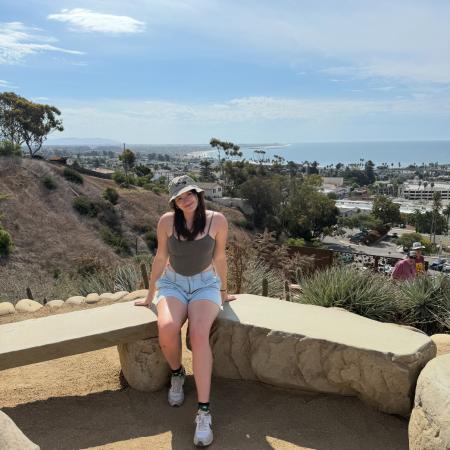
A week before the American Chemical Society Spring 2026 Meeting, graduate student Genevive “Jennie” Sheehan was asked to prepare an oral presentation for an audience of some of the most highly regarded chemists working today.
“I read [the email] maybe twenty minutes before I was going to go print my poster,” Sheehan says.
With only a week to prepare her talk and slides, Sheehan pivoted from the poster she had created to a full-scale talk about her research into conjugated nanoparticles and how they can be used to spot the early signs of glaucoma.
Glaucoma, Sheehan explains, happens when there is a build-up of fluids in the eye. These build-ups press on the optic nerve, causing patients to begin losing their sight. The current glaucoma testing method, OCT, finds the problem too late in the game, Sheehan says. “By the time glaucoma’s able to be detected using OCT measurements, thirty to fifty percent of the cells are already dead.”
In order to catch glaucoma before it’s able to do so much damage to the eye, Sheehan, along with her principal investigator (P.I.) Marilyn Mackiewicz and the rest of her team, developed a tool for looking closely at a part of the nervous system called the axon, where initial glaucoma damage starts to happen. “Axons, made of retinal ganglion cells, are the highway to the brain,” Sheehan explains, “because they transfer visual information, and axonal transport facilitates that by moving organelles, mitochondria, and proteins to and from the brain.” As glaucoma worsens, the axon’s neurotubules—key parts of the axon’s structure that allow that visual information to travel—get compressed. This is what causes people to start losing their ability to see.
Sheehan’s collaborator Dr. Brad Fortune at the Legacy Devers Eye Institute found that the protein Cholera Toxin B (CTB), a non-toxic form of cholera, targets the retinal ganglion cells that make up the axon. This protein allows Sheehan’s team to catch the initial warning signs of glaucoma. Using the protein as a guide, the team assesses axonal health using three different high-quality imaging techniques. “Our platform uses CTB, an Oregon Green Fluorophore, and the silver nanotriangle, so we can see it across all three imaging modalities. Each component of the platform is designed to address the challenges of each technique,” Sheehan says. This process gives the team the full picture of the damage in early stages of the disease, when more of the patient’s eyesight can potentially be saved.
Sheehan has been investigating nanomaterials and their potential use in healthcare. Sometimes, this means taking an approach that seems, at first glance, like it wouldn’t be useful. But with some clever chemistry and bioengineering, Sheehan and her colleagues can turn those unconventional ideas into potential breakthroughs.
“A nanoparticle seems like it’s probably not that useful in the body, but the way that we attach a lipid membrane to it, it makes it biologically stable, which is great,” Sheehan explains. “From there, we can attach proteins and peptides to that membrane, which is what I did for my project.” Sheehan and her team found a way to engineer a tiny particle to find the early signs of vision loss, all while moving safely and seamlessly through the body.
Thanks to a combination of her own drive and her P.I. Marilyn Mackiewicz’s encouragement, Sheehan traveled to Atlanta, GA, to participate in their Spring 2026 meeting and discuss her nanoparticle research.
The ACS Spring 2026 meeting was not Sheehan’s first conference, but it opened her eyes to how huge these conferences could be, and how many different ideas could be shared in one space at one time.
“It was just generally a super fun experience,” she says. “I’m really fortunate as a first-year master’s student to go.”
The meeting got Sheehan talking with chemists from around the world and seeing their work. She was especially fascinated by organoids—clumps of cells grown in a lab that can act like a brain, heart, liver, or other complex tissue structure in the human body. These tiny pseudo-organs let scientists see how actual human organs work in real time, including how they respond to drugs and disease. Sheehan and her P.I. are talking about working on an organoid project with one of the researchers they met at the ACS meeting.
Sheehan also met with researchers working on similar topics but taking a different approach. “We all have a similar goal of trying to make [nanoparticles], but everyone has a different way of going about it,” Sheehan says. Her conversations with these researchers inspired her to try some new tactics that might help her lab improve its environmental impact. “Our chemistry’s pretty safe, but we want it to be even safer and even more eco-friendly,” she says.