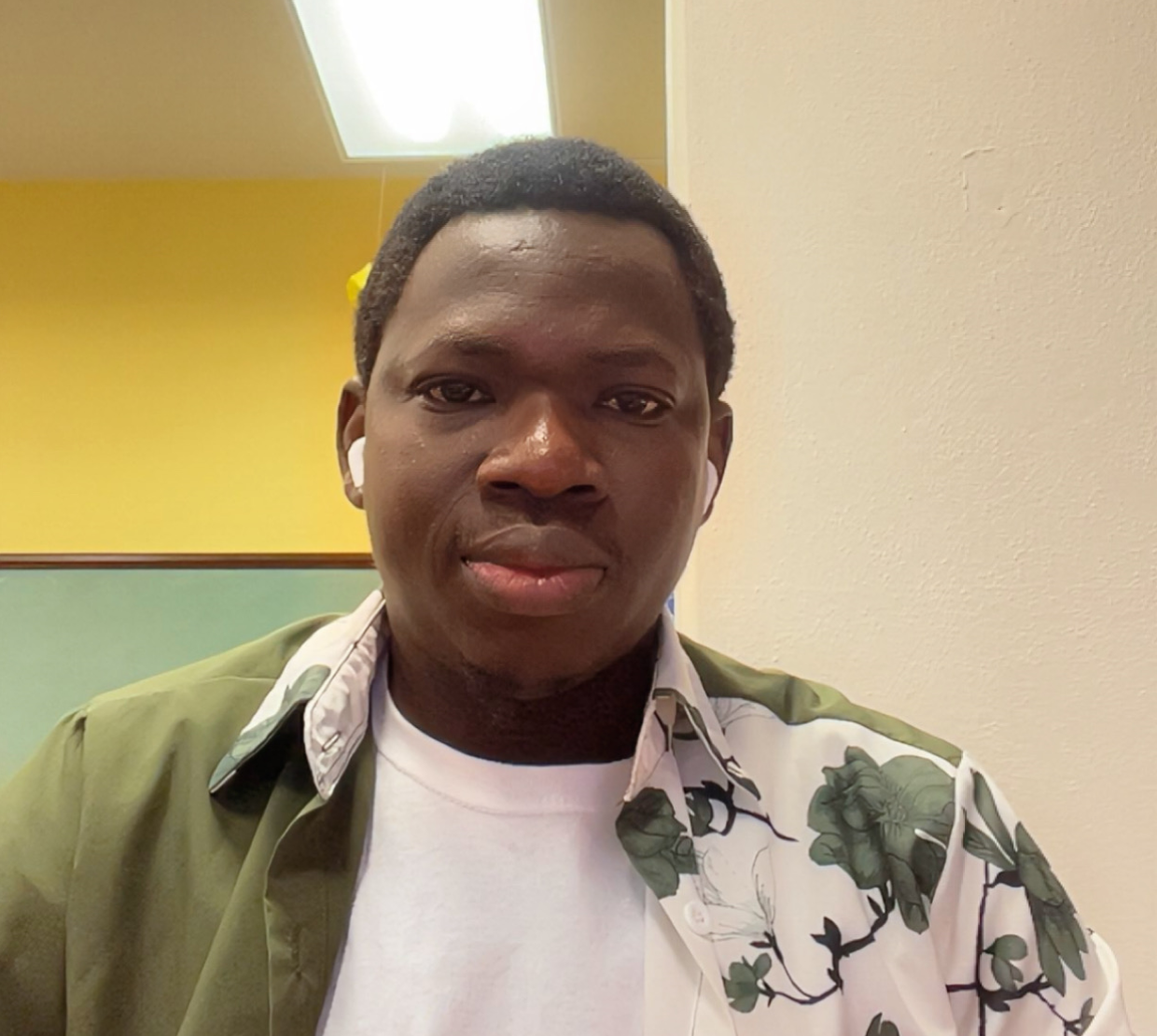
“Beyond being a scientist,” says Doctor Stephen, this term’s Graduate Student of the Quarter, “one of my interests is contributing to the society where I find myself.”
Helping others is a major part of Doctor’s life, whether through scientific discovery or community building. “If I weren’t a scientist,” he says, “I would probably be out there volunteering everywhere, helping people however I could.”
Raised in Barde, Kaduna State, Nigeria, Doctor developed an interest in chemistry because of its potential to provide real solutions to complex problems. He graduated with honors from Kaduna State University, where his undergraduate thesis focused on using titanium dioxide to degrade harmful organic pollutants. Doctor chose Oregon State University as a place to continue his studies due to its excellent research environment and opportunities for innovation. Working under the mentorship of Professor May Nyman has enabled him to continue exploring practical, real-world solutions through his research.
Currently, Doctor’s research focuses on what he describes as “working on the separation of critical materials, with emphasis on rare earth and platinum group elements using metal-oxo cluster chemistry.” Essentially, his team is looking at strategies to selectively extract critical metals from industrial products and natural sources, enabling both sustainable recovery and reuse. “If we can understand what happens at the molecular level,” he explains, “we can optimize how effectively we extract and separate these critical elements.”
Under Prof. Nyman’s guidance, he published a paper demonstrating a significantly improved method for extracting palladium from a nickel system through the formation of oxocluster. They identified conditions under which palladium, a value-added byproduct of nickel mining, forms oxoclusters while nickel does not, thereby enabling efficient separation. Notably, they observed that using potassium countercations helps in ushering these palladium oxoclusters into the organic phase from aqueous phase at the interphase through ion-pairing, thereby achieving approximately 99.96% palladium recovery. With further optimization, this strategy could be applied to recover palladium from electronic waste, industrial waste streams, mining residues, and related materials.
One of the most significant and memorable experiences of Doctor’s graduate school was his internship at Oak Ridge National Laboratory in the summer of 2024. There, he worked with radium to study its coordination in chemistry and radiochemistry. Radium is widely used in radiotherapy for cancer treatment. “I had the opportunity to work with radium and witness its greenish glow—it was an amazing experience,” Doctor recalls. “It’s something I don’t think I could have experienced anywhere else.”
Doctor’s search for real solutions goes beyond his work in the lab. He also played a major role in the establishment of an elementary school in Nigeria. “Back in Nigeria,” he explains, “there was a community where many children were out of school because their families could not afford tuition.”
Hoping to help these children gain access to affordable education, Doctor reached out to a local pastor and requested permission to use the church hall as a learning space. There, children could study the Word of God (Bible) alongside foundational subjects such as reading, writing, mathematics, and science. With the support of volunteers, the initiative grew to serve nearly 300 children and teenagers. Through collaboration with the local church, the school is now licensed by the government and supported internationally, allowing students to learn without facing prohibitive fees. In addition, Doctor hired five teachers to provide extra lessons for the students, paying them from his own stipend.
Outside of school, Doctor likes to mentor others, to watch movies, read books (his favorite films and book are The Equalizer series and Failure is Not an Option by Gene Kranz, respectively), and get the rest he needs to do his research well. His favorite foods are pounded yam and egusi soup, as well as sandwiches.
After completing graduate school, Doctor hopes to continue his research in a national lab, but another possible alternative is to work in industry as an R&D scientist, improving the recycling of valuable metals and other materials in industrial settings.
Doctor’s advice for a new OSU student is to be intentional, seek mentorship, and not allow temporary setbacks to define their path. “Whatever decision you’re making today,” he says, “look down the road ten years from now. Imagine you’re there and looking back. Will you be proud of the decision you’re making now, or will you wish you had done something different?”